The Future of Alternative Investment Funds in India
The Future of Alternative Investment Funds in India: A Strategic Imperative for Uncertain Times
The Indian investment landscape has reached a turning point.
Across boardrooms, family offices, and private wealth conversations, the question is no longer whether alternative investments deserve a place in a sophisticated portfolio. It is how much, through which structure, and via which regulatory route. That shift — from peripheral curiosity to strategic necessity — has been building for years. In 2025 and 2026, it became undeniable.
India's Alternative Investment Fund industry has grown at a compound annual growth rate of nearly 30% over the past five years. Total commitments reached approximately ₹15.74 trillion — roughly USD 180 billion — by December 2025. Over the decade from September 2015 to September 2025, the CAGR was even more striking: 49.23%. More than 1,700 registered AIFs now operate in India. The number of accredited investors in the system surged from 649 in May 2025 to over 2,181 by February 2026.
These are not niche numbers. They are the signature of an industry that has crossed a structural threshold — from alternative to essential.
This article draws on the most current data and regulatory developments to set out the full picture: what is driving the growth, what the 2025 SEBI reforms mean in practice, where the opportunities are concentrated, and what sophisticated investors — HNIs, UHNWIs, NRIs, and family offices — need to understand before acting.
Why the Current Environment Demands a Rethink
Global financial markets have entered a period of sustained and structural uncertainty. Geopolitical tensions, fluctuating inflation, shifting monetary policies across major economies, and the volatility rippling through equity markets have created conditions that are genuinely difficult for traditional long-only portfolios to navigate.
India, while fundamentally sound, has not been immune. The market corrections of early 2025 were a live demonstration of what happens to portfolios concentrated in public equity when sentiment turns sharply. The BSE 500 TRI fell 3.43% in January 2025 and a further 7.74% in February. The Nifty 50 TRI fell 0.45% and 5.79% respectively across the same period. Long-only AIFs — those investing in public markets — saw average losses of 6.52% in January and 8.70% in February.
The data from that period also showed something else: what a structurally different portfolio can do under the same conditions.
Long-short Category III AIFs — those designed to profit from both rising and falling prices — limited average losses to just 1.45% in January and 3.09% in February. In January, nine long-short funds delivered positive returns. In February, 31 out of 33 tracked long-short funds outperformed the BSE 500, and 10 posted positive returns in a deeply negative market.
This is not an anomaly. It is the structural consequence of genuine diversification — portfolios with genuinely independent return drivers rather than correlated exposure to the same market sentiment.
Understanding the Three Categories of AIFs
India's AIF framework, governed by SEBI under the Alternative Investment Funds Regulations 2012, classifies funds into three distinct categories. Understanding what each category does — and what kind of investor it serves — is the starting point for any serious allocation decision.
Category I: The Engine of Innovation and Infrastructure
Category I AIFs invest in areas considered socially or economically beneficial — early-stage startups, SMEs, infrastructure, and social impact enterprises. Sub-categories include Venture Capital funds, SME funds, Social Impact funds, and Infrastructure funds.
Venture capital within this category provides exposure to India's technology and innovation ecosystem at the formation stage — before public market recognition and before institutional pricing. The risk profile is the highest in the AIF universe, but so is the potential upside for investors with the horizon and conviction to hold through the development cycle. Infrastructure funds offer a different character entirely: long-duration, stable cash flows tied to India's national development agenda — roads, ports, energy, and urban development.
As of December 2025, Category I commitments stood at ₹97,988 crore.
Category II: The Core of Private Markets
Category II is the dominant category by volume, accounting for approximately 75% of the total AIF market with commitments of ₹11,64,118 crore as of December 2025. It encompasses private equity funds, private credit funds, real estate funds, and distressed asset funds — all instruments that invest in private markets and generate returns through execution rather than market sentiment.
Private equity within Category II acquires significant stakes in unlisted companies with the goal of improving operations and exiting at a higher valuation. Private credit — one of the fastest-growing segments in the entire AIF universe — provides debt financing to companies that cannot access traditional bank lending, offering regular yields with lower volatility than equity. The Indian private credit market has already crossed USD 12 billion and continues to expand rapidly. Real estate funds invest across commercial, residential, and industrial properties, generating returns through both capital appreciation and rental income.
GHL India Ventures operates as a SEBI-registered Category II AIF, with a mandate focused on stressed real estate and early-stage venture capital. The fund's position within Category II reflects the deliberate, execution-driven nature of its investment approach — acquiring assets whose prices reflect temporary fear rather than permanent impairment, and deploying patient capital toward value recovery over a defined horizon.
Category III: Tactical, Absolute-Return Strategies
Category III AIFs employ complex trading strategies — including long-short equity, arbitrage, and derivatives positions — with the explicit goal of generating returns regardless of market direction. These are India's hedge funds. As of December 2025, Category III commitments stood at ₹3,11,944 crore.
As the early 2025 performance data demonstrated, Category III long-short strategies provide genuine downside protection in falling markets — not through diversification within correlated assets, but through the structural ability to profit from market declines. For HNIs with significant public market exposure, a Category III allocation provides a hedge that traditional asset classes simply cannot.
The 2025 SEBI Reforms: What Changed and Why It Matters
In late 2025, SEBI introduced a series of landmark reforms to the AIF regulatory framework — the most significant evolution of the rules since the original 2012 regulations. These changes are designed to align India's alternative investment ecosystem with global best practices, reduce compliance friction for sophisticated investors, and expand the pool of eligible participants. Every serious investor in the AIF space needs to understand what changed.
The Accredited Investor-Only Framework
SEBI formally recognised "AI-only" AIF schemes — funds that raise capital exclusively from accredited investors. These schemes operate under a significantly lighter regulatory touch, acknowledging that accredited investors have the financial sophistication to assess risk without the full suite of protections designed for retail participants.
The practical implications are meaningful. AI-only schemes can offer differential terms via side letters — exempted from standard pari-passu rights requirements — allowing fund managers to customise arrangements for specific investors. Fund tenure can be extended by up to five years, compared to the previous two-year limit. And accredited investors are excluded from the 1,000-investor limit per scheme, removing a structural ceiling that had constrained fund size.
The accredited investor population is growing rapidly — from 649 in May 2025 to 2,181 by February 2026 — and the AI-only framework is specifically designed to serve this expanding constituency.
Large Value Fund Reforms
Large Value Funds are a sub-category of AI-only schemes designed for the highest-conviction, largest-ticket investors. The 2025 reforms overhauled the LVF framework in three significant ways.
The minimum investment threshold was reduced from ₹70 crore to ₹25 crore, meaningfully expanding the pool of eligible participants beyond ultra-HNWIs to include the broader HNI community with significant but not extreme wealth. Concentration limits were raised — LVFs can now invest up to 50% of their corpus in a single company for Category I and II funds, compared to the standard 25% limit — allowing fund managers to build higher-conviction, more concentrated portfolios. And LVFs were exempted from the standard Private Placement Memorandum template and from the annual audit of PPM terms, reducing operational friction and compliance cost.
The Angel Fund Overhaul
India's angel fund framework was comprehensively restructured to become AI-centric. All new angel funds must raise capital solely from accredited investors. Operations moved from deal-by-deal scheme structures to fund-level investing, and investment thresholds were rationalised — with a minimum of ₹10 lakh and a maximum of ₹25 crore per investment.
Taken together, the 2025 reforms represent a maturing regulatory posture: tailoring compliance requirements to investor sophistication rather than applying a uniform protective framework regardless of who is investing. The result is a more flexible, more efficient, and more internationally competitive AIF ecosystem.
Where the Opportunities Are Concentrated
The Indian AIF market in 2026 offers a diverse and expanding spectrum of investment opportunities across all three categories.
Private Credit: Filling the Financing Gap
Private credit has emerged as one of the most significant growth stories in Indian alternative investing. As banks face tighter regulatory capital requirements and become more selective in their lending, a structural financing gap has opened for mid-market companies — too large for microfinance, too small or too complex for easy bank lending. Private credit funds are filling that gap, offering tailored debt financing with covenants, security structures, and yield profiles that banks cannot match.
The Indian private credit market has already crossed USD 12 billion and is on a trajectory that analysts expect to accelerate significantly as the financing gap widens and the asset class becomes better understood. For investors, private credit offers regular yields, defined duration, and lower mark-to-market volatility than equity — a combination that is particularly attractive in uncertain macro conditions.
Distressed Real Estate: The Mispricing Opportunity
India's real estate sector carries a significant volume of stressed assets — properties, land banks, and development projects whose valuations have been compressed by developer distress, legal complexity, or sectoral sentiment, rather than fundamental impairment. As the IBC framework has matured and resolution processes have become more structured, these assets are surfacing through organised channels — creating an accessible and growing supply of investable opportunities for funds equipped to evaluate them.
For Category II AIFs with the expertise to distinguish temporarily mispriced assets from genuinely impaired ones, distressed real estate represents a return source unavailable in public markets: acquisition at a discount to intrinsic value, operational recovery through deliberate execution, and realisation of the gap between entry price and fundamental worth as conditions normalise.
REITs, InvITs, and Fractional Real Estate
While not AIFs themselves, Real Estate Investment Trusts and Infrastructure Investment Trusts represent a growing adjacent opportunity. Listed REITs now have a market capitalisation exceeding USD 10 to 12 billion in India, offering liquid, yield-bearing access to institutional-grade commercial real estate and infrastructure assets. AIFs frequently invest in these instruments as part of broader real estate strategies, and their growth reflects deepening investor appetite for yield-generating alternative assets.
Fractional real estate — the co-ownership of high-value commercial properties by multiple investors — is also gaining traction, democratising access to asset classes previously available only to institutions.
Sector-Specific Tailwinds Through 2030
Looking forward, several sectors are positioned for disproportionate AIF investment activity. Renewable energy and climate technology, driven by India's sustainability commitments and global capital flows. Healthcare and life sciences, supported by demographic tailwinds and rising healthcare expenditure. Technology and digitalisation, where India remains a global centre of innovation and where VC and growth equity funds continue to finance the next generation of category-defining companies. And infrastructure, where the government's sustained investment agenda creates a multi-decade opportunity for funds investing in roads, ports, logistics, and digital connectivity.
The overall Indian asset management market is projected to grow at a 15.47% CAGR through 2030, with alternative assets forecast to be the fastest-growing segment. Given current momentum, the AIF industry's asset base could realistically double or triple within that timeframe.
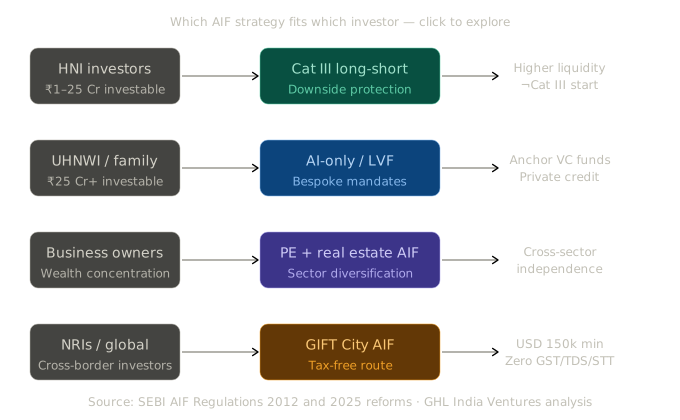
Who Should Allocate, and How
The right AIF strategy depends entirely on the investor's financial situation, risk tolerance, liquidity requirements, and investment horizon. There is no single approach — but there are clear patterns that match investor profiles to appropriate structures.
For HNIs building beyond traditional assets. Investors with a solid foundation in listed equities and fixed income, seeking the next layer of portfolio enhancement, should consider starting with Category III long-short funds for downside protection and lower-volatility exposure to alternative strategies. The revised LVF framework, with its ₹25 crore entry point, now makes high-quality private equity accessible to the broader HNI community without requiring ultra-HNWI scale.
For UHNWIs and family offices. This investor class is ideally positioned to take full advantage of the AIF spectrum. The flexibility of AI-only and LVF schemes enables bespoke investment mandates, higher concentration in high-conviction ideas, and direct participation in India's growth story at the private market level. Acting as anchor investors in Category I VC funds provides early access to disruptive technology companies. Building a diversified portfolio of private credit funds generates stable income with defined duration.
For business owners seeking diversification. Entrepreneurs with significant wealth concentrated in their own enterprise face a specific and underappreciated concentration risk. AIFs provide a powerful diversification tool — investing across private equity, real estate, and credit funds creates exposure to entirely different sectors, asset types, and economic drivers. The result is a wealth-generation engine independent of the primary business.
For NRIs and global investors. India's Gujarat International Finance Tec-City has emerged as the premier gateway for international investors seeking access to Indian AIFs. The tax advantages available through GIFT City are, simply put, extraordinary — and for NRIs in particular, they transform the economics of AIF investing in a way that mainland structures cannot match.
The GIFT City Advantage for NRIs
For non-resident Indians investing through an AIF domiciled in GIFT City, the tax environment is structurally different from anything available through mainland investment routes.
Capital gains on transfers of GIFT City AIF units are effectively tax-free for NRIs resident in zero-tax jurisdictions such as the UAE — a complete exemption unavailable through mainland structures. There is no Tax Deducted at Source on distributions or redemptions, improving cash flow and eliminating the administrative burden of TDS claims. All transactions on IFSC exchanges are exempt from Securities Transaction Tax and Commodity Transaction Tax. Fund management and advisory fees, which attract 18% GST on the mainland, are entirely GST-exempt in GIFT City — directly reducing the cost of investment.
The minimum investment for NRIs through a GIFT City AIF is typically USD 150,000. For investors who meet that threshold, the regulatory and tax environment is comparable to global financial hubs including Singapore and Dubai — with the additional advantage of direct exposure to India's growth story.
GIFT City is also evolving in the opposite direction — becoming a platform through which Indian UHNWIs and family offices can access global markets. AIFs based in GIFT City can invest in international assets, allowing domestic investors to build globally diversified portfolios from a tax-efficient Indian platform.
Tax Efficiency: The Pass-Through Structure
For Category I and Category II AIFs investing on the mainland, the Indian tax framework provides a significant structural advantage through pass-through taxation. Income generated by the fund — other than business income — is taxed directly in the hands of investors, not at the fund level. This avoids double taxation and preserves the character of the income, allowing investors to benefit from applicable concessional tax rates on long-term capital gains, dividends, and other income streams.
This structure aligns the tax treatment of AIF investing with the actual economic reality — investors are taxed once, on income that flows through to them, at rates appropriate to the income type. Understanding the interaction between fund structure, income character, and investor tax residency is essential for optimising the net return from any AIF allocation.
Risks Every AIF Investor Must Understand
The case for alternative investments is compelling. But AIFs are sophisticated instruments with characteristics that differ fundamentally from public market investments, and every investor must understand these differences before committing capital.
Illiquidity and lock-in periods. Category I and II AIFs are illiquid by design. Capital is typically committed for 7 to 10 years or longer. There is no secondary market for most AIF units. Investors must have a genuine long-term horizon and should not commit capital that may be needed in the short to medium term.
Minimum investment thresholds. Despite recent reforms, AIFs remain the domain of sophisticated investors. Minimum investments start at ₹1 crore for most mainland AIFs and reach ₹25 crore for LVF structures.
Fee structures. AIFs typically operate on a management fee of 1.5 to 2% of committed corpus, plus a performance fee — carried interest — of 15 to 20% of profits above a defined hurdle rate. These fees are not trivial and have a material impact on net returns. Investors must model the full fee waterfall before comparing AIF returns to alternative uses of capital.
Regulatory and market risk. The AIF regulatory environment has been consistently progressive under SEBI, but it continues to evolve. Future regulatory changes could affect fund structures, taxation, or permissible investment activities. Private market investments are also not immune to broad macroeconomic downturns — valuations and exit timelines can be affected by conditions outside the fund's control.
Manager selection. In private markets, manager quality is the single most important determinant of return. Unlike public market indices where passive vehicles are viable, AIF performance is driven by the expertise, relationships, and execution capability of the investment team. Due diligence on track record, team, strategy, and governance is not optional — it is the most important step in the investment process.
The Strategic Takeaway
The evidence assembled from India's AIF industry in 2025 and 2026 points in one direction. Alternative Investment Funds have moved from a niche allocation to a strategic necessity for sophisticated investors navigating genuine uncertainty.
The industry's growth — nearly 30% annually, ₹15.74 trillion in total commitments, over 1,700 registered funds — reflects a fundamental shift in how India's most serious investors are building portfolios. The 2025 SEBI reforms have made the ecosystem more flexible, more accessible, and more aligned with global best practices. The opportunity set — private credit, distressed real estate, venture capital, infrastructure, structured credit — has never been broader or better structured.
The question for sophisticated Indian investors in 2026 is not whether to allocate to alternative investments. It is how to do so with the right structure, the right strategy, the right manager, and through the right regulatory corridor for their specific circumstances.
For HNIs building the next layer of portfolio resilience. For UHNWIs seeking bespoke private market exposure. For NRIs accessing India's growth story through the tax efficiency of GIFT City. And for all investors who have recognised that public markets alone cannot provide the diversification, the downside protection, or the access to India's private economy that the current moment demands.
GHL India Ventures, as a SEBI-registered Category II AIF headquartered in Chennai, operates precisely within this landscape — bringing structured discipline, deep sector expertise, and a patient, execution-driven investment approach to the opportunities that India's distressed real estate and early-stage venture capital markets present.
For more information, visit ghlindiaventures.com
This article draws on publicly available industry data, SEBI disclosures, and research published through March 2026. It is for informational purposes only and does not constitute investment advice or an offer to invest. GHL India Ventures is a SEBI-registered Category II Alternative Investment Fund. Investments in AIFs are subject to market risks, including illiquidity and loss of principal. Please read all scheme-related documents carefully before investing. Past performance is not indicative of future results.